


If you learned about mitochondria in high school biology, you were likely taught a neat, mechanical analogy: they are the "powerhouses of the cell," acting as tiny biological batteries that burn fuel to produce ATP.
But according to Dr. Martin Picard, an Associate Professor of Behavioral Medicine in Psychiatry and Neurology at Columbia University, this traditional model is oversimplified to the point of being a mischaracterization.
Dr. Picard’s pioneering field of mitochondrial psychobiology reveals that mitochondria are not mindless engines. Instead, they operate as a highly integrated, distributed computing network within our cells—a system his lab terms the Mitochondrial Information Processing System (MIPS). They act as the biological "CEOs" of our cells, sensing environmental inputs, psychosocial stress, and emotional states, and translating that data into systemic biological instructions.
Crucially, Picard posits that our psychological experiences and physical cellular energy exist on the exact same continuum. When we experience mental exhaustion or resilience, we are experiencing the literal status of our mitochondrial energy flux. To optimize this budget, we must move past basic nutritional metrics and look at lifestyle interventions that fundamentally reset our cellular computing networks. Among the most powerful tools at our disposal are two ancient practices backed by cutting-edge bioenergetic science: meditation and massage therapy.
1. The Brain’s Energy Crisis & Mitochondrial Allostatic Load
To understand why practices like meditation and massage are clinically vital, we must understand how psychological strain depletes our physical hardware.
The human brain is a hyper-metabolic organ, consuming roughly 20% of the body's total energy budget despite making up only 2% of its weight. Dr. Picard’s mapping projects, such as the MitoBrainMap, show that the cortical areas responsible for complex emotional regulation, executive function, and stress adaptation are packed with the highest densities of complex mitochondrial networks.
When we encounter chronic psychological stress, our brain demands a massive energy surge. This sustained demand induces what Picard calls Mitochondrial Allostatic Load (MAL). Under excessive allostatic load, mitochondria undergo structural degradation: they shrink, misalign, fragment, and lose their capacity to efficiently transform energy.
This cellular energy deficit manifests subjectively as brain fog, acute anxiety, and depressive symptoms. When pushed past their structural breaking points, strained mitochondria can even leak their own internal DNA (mtDNA) into the bloodstream, triggering systemic inflammatory cascades that mimic bacterial infections and contribute to autoimmune issues.
The Scientific Shift: Under stress, the MIPS shifts into an emergency defense mode. Mitochondria divert their finite energy budget away from long-term maintenance, cellular repair, and neuroplasticity, and redirect it entirely toward immediate survival and systemic inflammation.
2. Meditation as a Metabolic Circuit Breaker
Through the lens of Picard's framework, mindfulness meditation is far more than a psychological coping mechanism; it is a physical metabolic circuit breaker that directly preserves your cellular energy budget.
Quenching the Brain's Power Surge
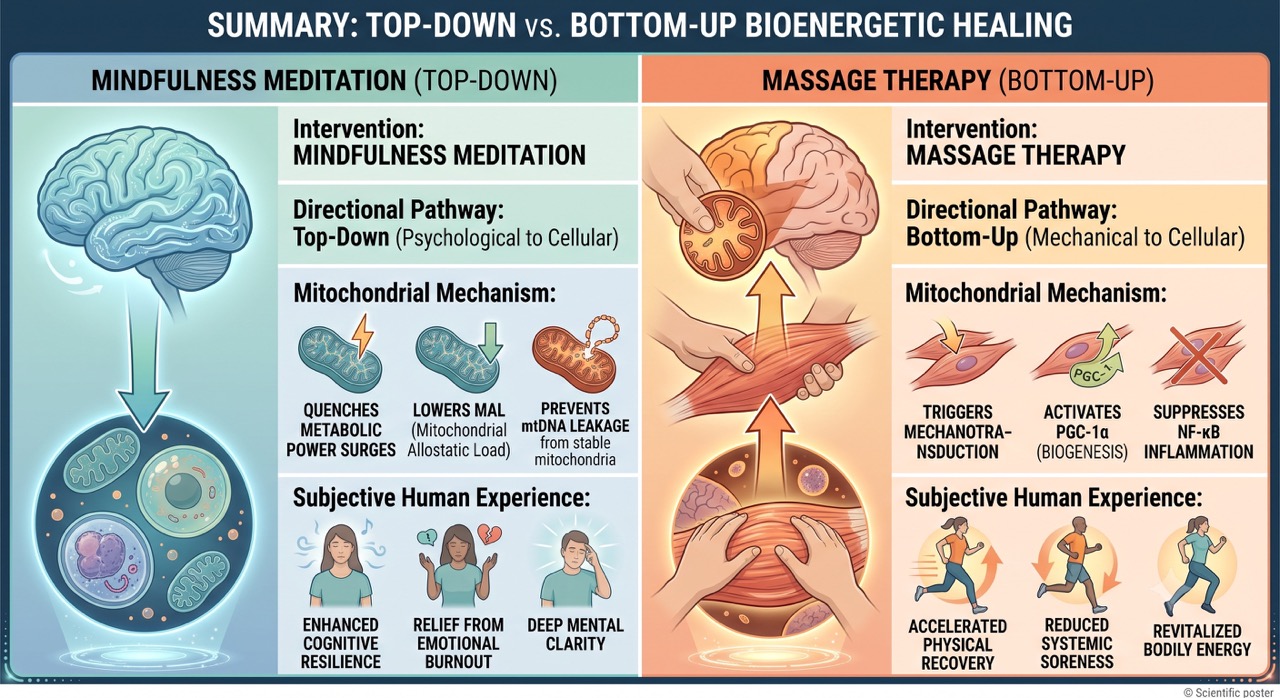
When you sit for meditation, you voluntarily limit external stimuli and downshift your autonomic nervous system from a sympathetic ("fight-or-flight") state to a parasympathetic ("rest-and-digest") state. This downshift immediately lowers heart rate, oxygen consumption, and circulating stress hormones like cortisol. By quieting hyperactive neural pathways, meditation effectively halts the costly bioenergetic power surge occurring in the brain's emotional networks, drastically reducing Mitochondrial Allostatic Load.
Preventing Cellular DNA Leaks
By preventing the structural over-activation of mitochondria, mindfulness protects their outer membranes. When mitochondria are kept stable, they cease emitting cellular "S.O.S." signals. This means they stop leaking cell-free mitochondrial DNA (cf-mtDNA) into the cytosol and extracellular space. As a direct consequence, the innate immune system avoids falling into a state of panic, preventing the wasteful expenditure of metabolic energy on systemic inflammation.
Reallocating the Energy Budget
Once the perception of a psychological threat is cleared, the MIPS receives a systemic signal of environmental safety. With the emergency survival mode deactivated, mitochondria can reallocate their energy production toward long-term biological maintenance. This includes accelerating cellular cleanup (mitophagy), increasing cellular repair, and powering the ATP-dependent pathways required for neuroplasticity—the brain's physical ability to adapt, heal, and form new structural connections.
3. Massage Therapy: The Biological Squeeze That Rebuilds Batteries
While meditation works from the top down, shifting biology through psychological stillness, massage therapy works from the bottom up, using physical mechanical forces to communicate directly with our cellular networks. Massage represents an extraordinary demonstration of mechanotransduction—the process by which cells translate physical pressure into chemical and genetic instructions.
Upregulating Master Genetic Switches
A landmark clinical study published in Science Translational Medicine evaluated muscle tissue biopsies before and after a brief 10-minute massage session. The molecular analysis revealed that the mechanical pressure applied to muscle fibers and fascia explicitly activates focal adhesion kinases, which signal the cell nucleus to upregulate PGC-1α (peroxisome proliferator-activated receptor γ coactivator 1α).
In bioenergetics, PGC-1α is recognized as the master genetic switch for mitochondrial biogenesis—the birth of entirely new mitochondria. By manually manipulating tissue, massage therapy acts as a literal biological cue that orders the body to expand its cellular battery capacity, doubling down on its long-term ability to transform energy efficiently.
Dampening the Inflammatory Drain
The same cellular research demonstrated that a single targeted massage session radically dampens the expression of NF-κB (nuclear factor kappa-light-chain-enhancer of activated B cells), a major pro-inflammatory transcription factor. It simultaneously downregulates systemic inflammatory cytokines such as TNF-α and IL-6.
In Picard’s framework, inflammation is an incredibly expensive metabolic process; it acts as a massive drain on your daily energy allocation. By forcefully shutting down this localized and systemic inflammatory "noise," massage therapy plugs a profound metabolic leak, instantly conserving a substantial percentage of your body's net energy budget for cognitive clarity and physical performance.
Summary: Top-Down vs. Bottom-Up Bioenergetic Healing
4. Designing Your Bioenergetic Protocol
Integrating these findings into a functional routine does not require endless hours or expensive equipment. Instead, it requires tactical consistency to manage your body's energy flow:
- The Morning Buffer: Dedicate 10 minutes every single morning to basic mindfulness or breathwork. Treat this as an essential preventative shield that stops early morning psychological stressors from triggering mitochondrial defense modes later in the day.
- The Pre-Sleep Wind Down: Minimize intense cognitive processing and dim external lighting 30 to 60 minutes before sleeping. This consciously lowers the metabolic price of consciousness, allowing mitochondria to shift gracefully into cellular repair mode ahead of your actual sleep cycle.
- Strategic Somatic Care: View regular bodywork or massage therapy not as a luxury, but as a biological requirement for mitochondrial biogenesis. Even brief, consistent foam rolling or self-massage can stimulate mechanotransduction pathways, encouraging your cells to build more energetic infrastructure.
Conclusion: The True Source of Vitality
Dr. Martin Picard’s work reminds us that human health is fundamentally dynamic and energetic. We cannot separate the psychological way we feel from the microscopic way our cells convert food and oxygen into life.
Meditation and massage are not merely methods to pamper the body or calm the mind; they are profound, evidence-based interventions that interact directly with our cellular computing networks. By intentionally altering our mental states and manipulating our physical tissues, we clear the internal resistance to energy flow, dismantle our allostatic load, and physically rebuild our body's capacity for deep, vibrant life.